
Map your course#
Before you set off into a new subject, it helps to see the whole territory laid out — the major regions, how they connect, where you’re heading. A course map gives you that overview. It’s a high-level view of the topics you need to learn to reach your objective, before you drop down into the detail of any one of them.
This isn’t just tidiness. When you meet a new fact, your mind has to file it somewhere. If you’ve already seen the shape of the subject, every new piece has a place to go — it slots into a structure you’ve prepared. If you haven’t, you’re trying to build the filing cabinet and stuff papers into it at the same time. Educational psychologist David Ausubel made this point decades ago with what he called advance organisers — a brief overview given before the detail, at a higher level of generality, that the incoming material can hook onto. His often-quoted line was that the single most important factor influencing learning is what the learner already knows; a course map is you deliberately giving yourself that scaffold up front.
What a course map is#
I define a course as “a study or training effort with a clear objective at the end.” I like to break a course down into streams and modules:
- A stream is a group of related modules, usually either theory or practice.
- A module is a group of related lessons or exercises within a stream.
Take flight training. It usually has a flight-practice stream and a theory stream, with many modules in each. Below is an example course map for reaching one major stage of a pilot’s licence.
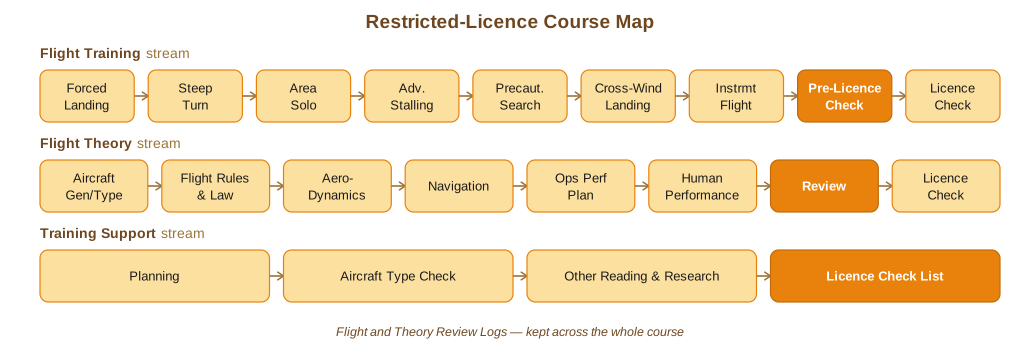
In that example, someone else has already worked out a well-defined map for gaining a pilot’s licence. Many goals come with one ready-made — a syllabus, a certification path, a textbook contents page. Don’t reinvent a map that already exists; borrow it. Where no map exists, you create your own, and that act of mapping is itself part of the learning.
You can break a course down in whatever way suits you, so don’t get hung up on my terminology. Streams and modules are just my labels — use what makes sense to you and your objective. The goal is simply to end up with a clear picture of the whole course.
Make the map yours#
There’s a difference between being handed a map and drawing one. A syllabus you skim is someone else’s organiser; it works, but lightly. A map you sketch yourself — even a rough one — forces you to decide how the pieces relate, and that’s where most of the value sits.
This is the natural bridge into concept and mind mapping. A course map is really just a concept map at the coarsest grain: boxes for the big topics, lines for how they connect. The same instrument you use here to plan, you’ll use again to organise, practise and review. The research on study maps is encouraging here. A meta-analysis by Nesbit and Adesope, pulling together dozens of studies, found that constructing or studying concept and knowledge maps tends to produce better recall and understanding than reading the same material as plain text — modest but consistent gains. Drawing your own map is a small upfront cost that pays back across the whole course.
If you want to go further than a sketch, the Memletics Concept and Mind Mapping course walks you through building maps properly — basic maps, common patterns, and tools for doing it on a screen. A course map is a fine first map to practise on.
How much detail?#
The depth of your map depends on the depth of knowledge your goal demands. A map for learning to drive a car needs far less depth than one for an engineering degree.
For most planning, the high-level course map is as far as you go right now. The fine-grained breakdown — splitting modules into individual pieces of knowledge you’ll learn and memorise — happens later, during your actual lessons and study. At this stage you just want the lay of the land.
The takeaway: sketch the whole territory before you walk into it. A course map — even a rough one you draw yourself — gives every new fact somewhere to land, and turns a wall of unfamiliar material into a journey with a visible route.