
Systems thinking and feedback loops#
In module 4 you met the systems map – the bucket filling from a hose, the four-stroke engine turning over and over – and the idea that some maps have no start or end point because their real subject is feedback. This module takes that one idea and gives it a proper treatment, because once you can see feedback you start seeing it everywhere: in a thermostat, a shower, a savings account, a forest, a market, a hospital ward, an AI agent steering toward a goal – and in your own learning.
That last one is not a stretch. The broader Memletics manual frames learning as a feedback loop on purpose: you attempt something, you find out how it went, and you adjust. By the end of this module you’ll see that the proven methods at the core of the manual – retrieval practice, Refresh Reviews, calibration – are not a grab-bag of study tricks but deliberately engineered feedback. You don’t just pour knowledge in. You steer it in.
A short word of honesty up front, because it threads through the whole module: the diagrams here are a thinking and communication tool. A tidy loop on a page can look more settled, more understood, more solved than the real system actually is. Treat each map as a careful hypothesis about how something behaves – not a proof that it does.
Causal-loop diagrams: the modern systems map#
The working tool of systems thinking is the causal-loop diagram (CLD). It’s the grown-up version of the systems map from module 4, and it’s deliberately spare. You only need two things:
- Variables as the nodes – things that can go up or down. Skill, confidence, room temperature, cash in the account. Notice these are quantities, not events: you write “water level,” not “fill the bucket.”
- Causal arrows between them, each carrying a polarity. An arrow tagged S (for same, sometimes written +) means the two variables move the same way: more of the first causes more of the second, and less causes less. An arrow tagged O (for opposite, sometimes −) means they move opposite ways: more of the first causes less of the second.
So “the more you practise, the more skill you build” is an S arrow from practice to skill. “The warmer the room, the smaller the gap to your target temperature” is an O arrow from room temperature to gap. That’s the whole alphabet. Everything else is built from it.
What makes it a systems diagram, rather than a flowchart, is that the arrows eventually close back on themselves into a loop. And every loop is one of exactly two kinds.
Reinforcing loops: things that amplify#
A reinforcing loop (marked R) is one where each trip round the circle amplifies the change rather than damping it. Push it a little and it runs away with itself – in whichever direction you pushed.
The clearest example for a learner is the one the manual cares most about:
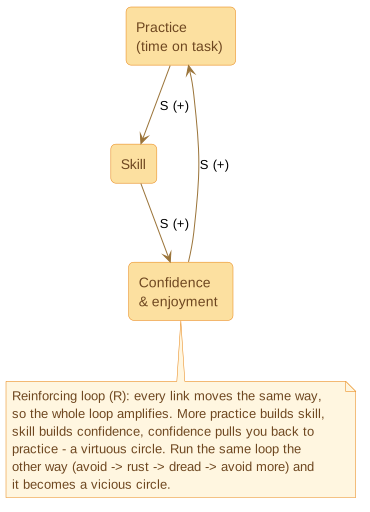
More practice builds skill; more skill makes the activity more rewarding, so your confidence and enjoyment rise; and enjoying it pulls you back to practise more. Every link is an S, so the loop feeds itself. Run it forwards and it’s a virtuous circle – the get-rich of skill, where the good get better faster. Run the very same loop the other way – you avoid the thing, the skill rusts, dread grows, you avoid it harder – and it’s a vicious circle. Same structure, opposite spin. (A quick rule of thumb: count the O arrows in a loop. An even number, including zero, makes it reinforcing.)
Reinforcing loops are behind most of the things that “snowball”: compound interest, a rumour spreading, a population growing, a habit hardening. They explain why momentum is real and why the early going is the hard part – you’re trying to get a reinforcing loop spinning before it starts paying you back.
Balancing loops: things that seek a goal#
The other kind is the balancing loop (marked B), and it’s the most important idea in the module. A balancing loop has a goal – a setpoint, a target, a desired level – and every time round, it acts to close the gap between where things are and where they should be. Instead of running away, it settles.
The bucket from module 4 was one of these. So is a thermostat:
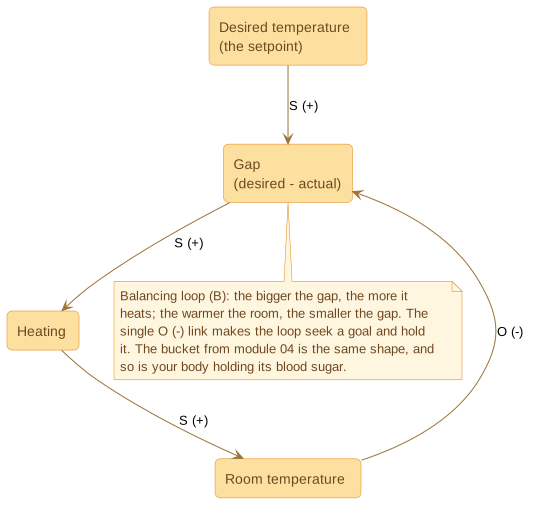
Read it round: the bigger the gap between the temperature you want and the temperature you’ve got, the more the system heats; the more it heats, the higher the room temperature; and – here’s the crucial link – the higher the room temperature, the smaller the gap. That last arrow is an O. It’s the one opposite link that turns the whole loop from a runaway into a self-corrector. (The rule of thumb again: a balancing loop has an odd number of O arrows – here, exactly one.)
Balancing loops are how systems hold themselves steady: a thermostat on a room, your body on its temperature and blood sugar, a cruise control on a speed, a business hiring up to meet demand and easing off when it’s met. Engineers call this negative feedback, and the study of such self-regulating, goal-seeking systems is cybernetics – a word worth keeping, because it comes from the Greek for steersman. A balancing loop steers.
Most real systems are a handful of reinforcing and balancing loops tangled together. Drawing them out – variables, polarities, each loop marked R or B – is what systems thinkers do before they trust their gut about how something will behave.
Delays: why feedback with a lag overshoots#
Here is the thing that trips everyone up, and the reason a balancing loop doesn’t always glide smoothly to its goal: delay.
You already know this one in your body, from the shower:
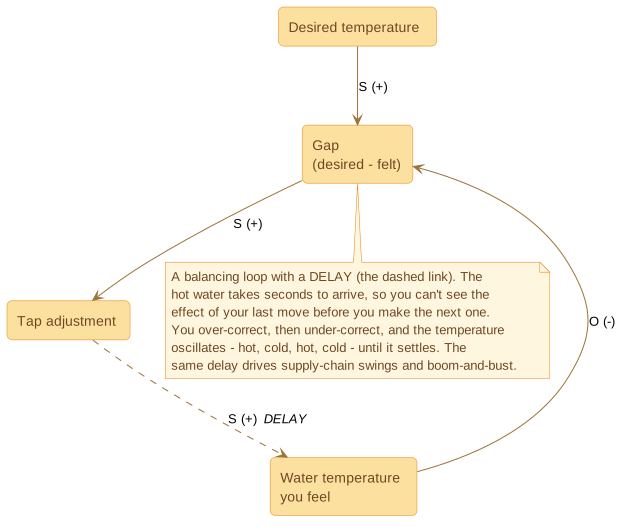
It’s the same goal-seeking loop as the thermostat, with one difference: a delay sits on the link between turning the tap and feeling the result (drawn as the dashed arrow). The hot water has to travel down the pipe. So you can’t see the effect of your last adjustment before you make the next one. You feel it’s too cold, you crank it hot, nothing happens yet, you crank it hotter – and then a wall of heat arrives all at once. You slam it back, over-correct the other way, and the temperature oscillates – hot, cold, hot, cold – until it finally settles.
That oscillation is not a sign you’re bad at showers. It’s the signature behaviour of a balancing loop with a delay in it. The longer the lag and the more aggressively you react, the wilder the swing. The same pattern plays out at every scale: stock and order swings rippling up a supply chain (the famous “bullwhip”), boom-and-bust in markets, a government tightening policy long after the problem has already turned.
For steering anything – including your own learning – delays carry one blunt lesson: act on fresh feedback, gently; distrust your urge to over-correct on stale feedback. Feedback that arrives long after the attempt teaches you far less, and tempts you into exactly the over-correction that makes things swing. This is one reason testing yourself today beats waiting for an exam result in three weeks: you’re shortening the delay in your own learning loop.
Stocks and flows (lightly)#
One more distinction is worth carrying, and you can hold it lightly. Some of the variables in a system are stocks – things that accumulate. Others are flows – the rates that fill or drain them.
The bathtub is the whole idea: the water in the tub is a stock; the tap is the inflow and the drain is the outflow. The level only changes through the flows, and – this is the part people get wrong – a stock can keep rising even as the inflow falls, as long as inflow still beats outflow. Your bank balance is a stock; income and spending are the flows. Your skill, or your fitness, or the carbon in the atmosphere – all stocks, all filled and drained by flows.
Why it matters in practice: stocks give a system memory and inertia. They’re why you can’t undo a year of neglect in a weekend, and equally why a steady daily flow quietly compounds into a large stock over time. When you find yourself frustrated that a change isn’t showing up yet, check whether you’re staring at a stock (which lags) while only the flow has actually moved. That’s all you need from stocks and flows here – the rest is for a deeper course.
Leverage: where to push#
If a system is a web of loops, the obvious question is: where do you push to change it? The systems thinker Donella Meadows spent a career on this and left us a useful, deliberately humble idea – leverage points, places where a small shift changes a lot.
The headline, kept honest, is that the obvious levers are usually the weak ones. Tweaking a number – a tax rate, a study timetable, the thermostat’s setpoint – is the lever everyone reaches for first, and it’s near the bottom of her list. The strong levers sit deeper: the rules of a system, the information flows (who can see what feedback, and how fast), the goals the loops are chasing, and – strongest of all – the mindset the whole thing rests on. Change what feedback a person can see, and you often change their behaviour without touching a single number.
Treat this as a direction to look, not a formula. Meadows herself warned that leverage points are not intuitive and that pushing the right one the wrong way can backfire. The honest takeaway for a learner: when something isn’t working, don’t only fiddle the dial. Ask whether the feedback is reaching you at all, and whether you’re aiming at the right goal. Often the leverage is in seeing the loop, not in straining harder on the lever you already hold.
Learning is a feedback loop#
Now we can close our own loop. Everything above was building to one claim the manual makes in earnest: learning is a feedback loop, and you can engineer it.
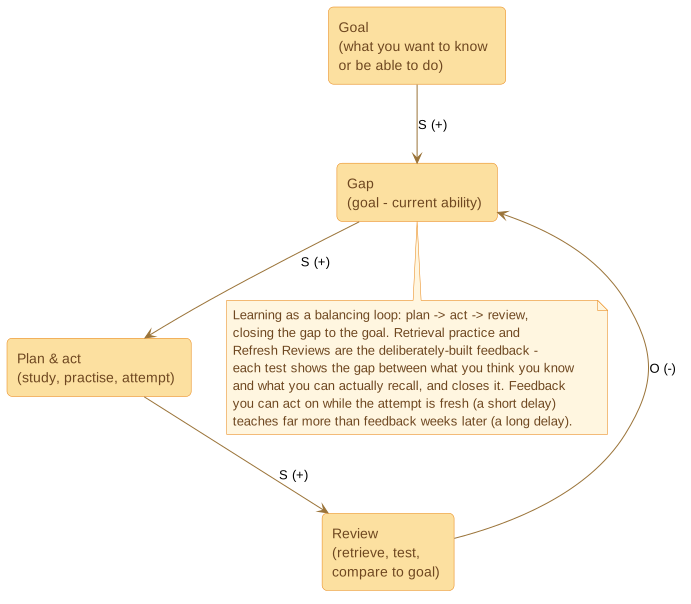
Look at the shape. You have a goal (what you want to know, or be able to do). The gap between that goal and your current ability drives you to plan and act – study, practise, attempt. Then you review: you find out how it actually went and compare it against the goal, which closes the gap. Plan, act, review. That’s a balancing loop, exactly like the thermostat and the bucket – a learner steering toward a target.
Three things fall out of seeing it this way:
- Retrieval practice and Refresh Reviews are feedback you build on purpose. Rereading your notes is pouring water into a bucket you can’t see the level of. Testing yourself – closing the book and retrieving – measures the level. Each retrieval attempt exposes the gap between what you think you know and what you can actually recall, and the act of closing that gap is what builds the memory. The proven methods page calls retrieval the single highest-value habit; in systems language, it’s the feedback sensor on your learning loop. Without it, you’re flying the loop blind.
- Calibration is closing the gap between predicted and actual. Before you check an answer, predict whether you’ll get it. The distance between your prediction and the result is your calibration error – and shrinking it is itself a feedback loop running on top of the first one. Good learners aren’t just more skilled; they have a more accurate read on what they do and don’t know, because they’ve been measuring the gap, not guessing at it.
- Mind the delay. A learning loop with a long delay – feedback that arrives weeks later – teaches slowly and tempts over-correction, just like the shower. Short, frequent feedback you can act on while the attempt is fresh is worth far more than a single distant verdict. Shorten the lag and the loop steers smoothly.
And here’s the wide-angle view, offered lightly because the shape really is the point: the same feedback lens runs from a thermostat to a hospital to an AI agent. A thermostat senses, compares to a setpoint, and acts. A hospital ward senses a patient’s vitals, compares them to a target, and adjusts care. An AI agent takes an action, observes the result, compares it to its goal, and tries again. A learner attempts, reviews, and adjusts. Different substrate; same shape at every scale – a loop that senses a gap and steers to close it. That’s the cybernetic idea in one line, and it’s why “you steer learning, you don’t just pour it in” is more than a slogan. It’s the structure.
Cybernetics — the science of steering (the short version)#
That loop has a name: cybernetics. The word comes from the Greek for steersman — the person at the ship’s tiller — and that’s really all cybernetics is: the science of steering by feedback. Sense where you are, compare it to where you want to be, nudge, and repeat. A thermostat does it with temperature, your body does it with blood sugar, a sailor does it with a tiller — and you do it every time you test yourself, see the gap, and study what you missed. Same idea, wildly different machinery.
It also sorts the diagrams in this course into two families, worth naming once:
- Maps you draw to understand — most of them: concept, mind, systems, causal-loop. You build them to get a system clear in your own head. The picture is scaffolding; once you’ve understood, you can throw it away.
- Maps you draw to run — a decision flowchart or a state diagram (module 4 ) can be compiled and executed: the picture you read is the rule the machine follows. Here the diagram isn’t scaffolding — it’s the thing itself.
The decision flowchart sits right on the boundary: you draw it to think and it can run. That’s the whole arc in miniature — a diagram that helps a person understand a system is the close cousin of a diagram that steers one.
More on this is coming. Cybernetics — how feedback steers everything from a thermostat to a team to an AI — is a rich subject we’re building out into its own fuller treatment. For now the one-line version is enough to use: find the loop, and steer it.
Honest limits#
Causal-loop diagrams are powerful precisely because they’re simple – and that simplicity is also their trap. A few cautions to keep them honest:
- A clean loop is a claim, not a fact. Drawing an S or an O on an arrow asserts that one thing reliably moves another. Real arrows have conditions, exceptions, and thresholds your diagram quietly hides.
- The polarity can flip. “More heating raises temperature” – until the window’s open, or the system’s already saturated. Loops that hold in one regime can reverse in another.
- A tidy map feels like understanding. The danger isn’t that the diagram is wrong; it’s that it’s seductive. A neat circle on a slide can settle a debate that the real system hasn’t settled at all.
So use these maps the way you’d use any good map: to think more clearly and to communicate a hypothesis – then go and check whether the territory agrees.
Summary#
A causal-loop diagram is the modern systems map: variables as nodes, arrows carrying a polarity (S/same or O/opposite; +/−), and arrows that close into loops. Every loop is either reinforcing (it amplifies – virtuous and vicious circles, an even number of O links) or balancing (it seeks a goal and holds it – a thermostat, the bucket, an odd number of O links). Delays in a loop cause overshoot and oscillation – the shower going hot-cold-hot – which is why fresh, gentle feedback beats stale over-correction. Stocks accumulate and lag while flows fill and drain them, giving systems their inertia. Leverage – where to intervene – usually sits deeper than the obvious dial: in the feedback, the goals, and the mindset. And learning is itself a balancing loop – plan, act, review – in which retrieval practice and Refresh Reviews are deliberately-built feedback and calibration is closing the gap between what you predicted and what was true. The same shape runs from a thermostat to a hospital to an AI agent: a loop that senses a gap and steers to close it. You steer learning; you don’t just pour it in. Just remember a tidy loop is a hypothesis to test, never a proof.
Exercises#
Exercise 1 – Build a reinforcing loop#
Pick something in your own life that has “snowballed” – in a good direction or a bad one. A savings habit, a fitness streak, a procrastination spiral, a friendship that grew, a skill you let rust. Draw it as a causal-loop diagram:
- Name three or four variables (quantities that can go up or down – not events).
- Join them with arrows and tag each one S or O.
- Check that the loop closes, then count the O arrows. An even number means you’ve drawn a genuine reinforcing loop. Mark it R.
- Now describe, in one sentence, what would happen if the loop ran the other way. (The same structure usually gives you both the virtuous and the vicious circle.)
Exercise 2 – Build a balancing loop for your own learning#
Take one thing you’re currently trying to learn or improve. Draw the plan – act – review loop for it specifically:
- Put your goal at the top, then the gap, your action, and your review (how you actually find out how it’s going).
- Tag the arrows. You should end up with exactly one O arrow – the one running from “review” back to the “gap.” Mark the loop B.
- Now find the honest weak link: where is the feedback thin, slow, or missing? If your only “review” is a distant exam, your loop has a long delay and a weak sensor. Add a tighter feedback arrow – a self-test, a quick retrieval check, a prediction-then-check – and note where it plugs in. That added arrow is you engineering your own feedback, which is the whole point of this module.