
Exploring in a logical mode#
A lot of learning material arrives as a string of claims you’re quietly expected to swallow whole. You can do better than swallow. When you stop to ask why something is true, how the pieces hang together, and whether the argument actually holds, you stop being a passenger and start working the idea — and worked ideas are the ones that stick. That’s logical exploration: meeting material with reasoning and structure rather than just reading it through.
This isn’t a mode reserved for “logical people” or the mathematically minded — and matching study to a supposed “logical style” isn’t the lever it was sold as (what the evidence really says about learning styles ). It’s a general tactic, available to every learner, and it leans on one of the better-evidenced things we know about studying: when you elaborate on material — generate reasons, explain the connections, ask and answer “why” — you understand and remember it far better than when you simply re-read it (Dunlosky et al., 2013). Below are three ways to do that on purpose.
Probe the logic — the OSAID check#
Don’t assume your material is right just because it’s printed. A great deal of what you read is the author’s reasoning, and reasoning can be sound or shaky. Get into the habit of testing the argument underneath a claim — the author’s, and your own. OSAID is a small mnemonic for five kinds of reasoning to look for:
- Objective. Is the argument built on facts? Ask: how do you know they’re facts? Could they be opinions or assumptions wearing a fact’s coat?
- Subjective. Is it built on opinion — the author’s, or someone they’re quoting? Ask: do you trust the source? How reliable is it?
- Assumptive. Is it resting on an unstated assumption? Ask: whose assumption, and what falls over if it’s wrong?
- Inductive. Does it reach a general conclusion from a few specific cases? Ask: can you think of a case that breaks it?
- Deductive. Does it reach a specific conclusion from principles taken as true? Ask: are those principles actually true, and is the step from them to the conclusion a fair one?
The point of OSAID isn’t to win arguments — it’s that the questioning itself is the learning. Working out which kind of reasoning a claim depends on, and where it’s vulnerable, forces you to engage with the material’s structure rather than skate over it. That active interrogation is exactly the kind of elaboration that deepens understanding, and it doubles as a defence against quietly absorbing something that’s wrong.
Build a logic tree#
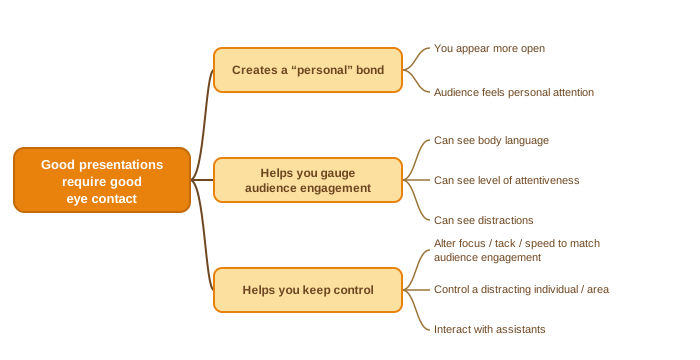
A logic tree is a simple diagram: a key statement at the top, then branches of supporting reasons or points underneath, each of which may branch again. It’s a way of making an argument’s shape visible — what’s load-bearing, what merely decorates, where a claim is propped up by one thin branch.
The discipline that makes a logic tree worth drawing is keeping each level MECE — mutually exclusive and collectively exhaustive. In plain terms: the branches at any one level shouldn’t overlap, and between them they should cover the whole of what’s above. Chasing that — no gaps, no double-counting — is what drags the fuzzy parts of your understanding into the light. If you can’t make a level MECE, you’ve usually found a spot where you don’t yet understand the topic as well as you thought, and that’s useful feedback, not a failure. If you want to push this further, read up on deductive and inductive reasoning and on structured problem-solving, where these trees come from.
Work it in numbers#
If a topic has numbers in it, explore them — don’t just read past them. Drop figures into a spreadsheet and graph a formula or a set of results, and a relationship that was invisible in a column of digits often jumps straight out: this rises as that falls, this one flattens off, that one runs away. You don’t need to be mathematical to get something from this; you only need to be willing to make the numbers move and watch what they do. As with a sketch or a logic tree, the value is in the doing — the act of setting up the graph and deciding what to plot against what is where the understanding happens.
The takeaway#
Logical exploration is reasoning treated as a study tool. Probe the argument under a claim with OSAID, lay an argument’s structure out as a logic tree, and put a topic’s numbers on a graph — and in each case you’re doing the same underlying thing: elaborating on the material instead of passively receiving it. It feels like more work than reading, because it is. That’s the point — the effort is where the learning lives. It’s a tactic for every learner, not a type, so reach for it whenever a topic has an argument or a structure worth taking apart.