
Reading paths#
A reading path is your plan for traversing a book. Before you start a long read, decide whether you’ll go front-to-back, skim everything before drilling into anything, or work chapter-by-chapter at increasing depth. The right plan depends on how the book is structured, how much of it you need, and how interrelated its chapters are.
This is a Locate-step concern: you’re deciding how to engage with material before you commit time to reading it.
Analyse your objectives and material first#
Before you pick a path, clarify what you’re trying to get out of the book and what kind of book you’re holding.
Questions about your objectives:
- What’s my purpose in reading this material? Is it directly related to my overall goals?
- How well does this material link to those goals?
- Specifically, what do I want to take from it?
- How much do I already know about the topic?
- How well do I need to learn and remember it?
Questions about the material:
- How difficult is it for me?
- How well structured is it? How is it organised?
- How has the author organised the chapters? Are chapters interrelated, or independent? Do I need to read in order, or can I jump?
- Does the introduction or foreword match my objectives?
- Are there summaries, reviews, exercises?
- Is there an index? A glossary I could use as a starting point for my new-word list?
- What do I know about the author? Are they likely to present factual or biased material?
- Will I need other books or materials alongside this one?
- Do I own the book? Can I write in it?
A few minutes of skim reading — covers, table of contents, index, introduction — answers most of the second list. The first list answers itself.
With those answers, decide. Skip, skim, read once at standard speed, or read several times at varying depths. Match your effort to the material’s relevance and difficulty.
The three reading paths#
Three patterns cover most situations. Choose the one that fits the book in front of you.
The straight-through path#
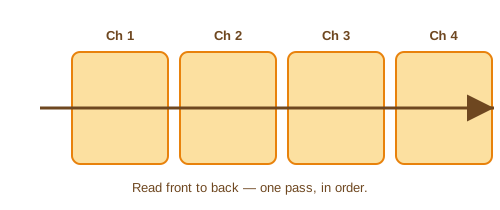
Read the book front to back, without skimming first. Use this when you’re reading for enjoyment (novels, biographies) or when you want a general understanding without needing to memorise the material.
The downwards path#
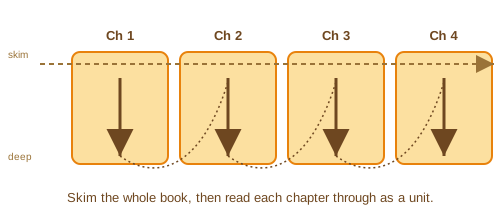
Skim the whole book first, then drill into each chapter as a separate unit. Use this when chapters are loosely related — each one is its own argument, and you can finish one before starting the next.
The initial skim lets you judge each chapter’s relevance to your goals. You may decide to skip some chapters entirely or read them in a different order than the author intended. You’re using your time on what matters to you.
The crossways path#
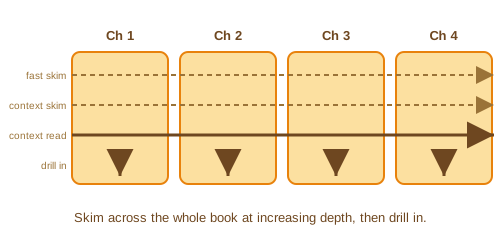
Skim across the entire book at increasing depth before reading any chapter in full. Use this when chapters are tightly related — when later chapters assume the content of earlier ones, or when concepts develop across the whole book.
The crossways pattern is: fast-skim everything, then context-skim everything, then context-read everything, then drill into individual chapters. By the time you read a chapter in detail, you have the full shape of the book in your head and you can read each chapter in the context of the others.
This path takes longer up front but gives you the best understanding of how the book’s ideas fit together. For complex technical material — a college textbook, a dense reference — it’s usually the right choice.
Choosing a path#
A quick guide:
- Straight-through — fiction, leisure reading, anything where understanding is incidental to enjoyment.
- Downwards — collections of essays, business books with independent chapters, reference books where you only need a few sections.
- Crossways — textbooks, technical manuals, anything where later material builds on earlier material.
The choice isn’t permanent. If you start with the downwards path and discover the chapters are more interrelated than they looked, switch to crossways. The point of choosing a path up front is to read deliberately — not to lock yourself in.
Where this fits#
Reading paths are part of the Locate step of the learning process: you’re planning how to gather knowledge from a source before committing to it. The companion piece — how attentively to read each section once you’re in it — lives under reading strategies . For the broader speed-reading context, see the speed reading course .