
Learn how to use powerful mind and concept maps effectively#
Many of you have heard of Mind Maps. Indeed, many arrive at Memletics.com looking for information on how to use mind maps for learning. Are you ready for more powerful concept mapping techniques?
Mind Maps are one type of concept map made popular by Tony Buzan. What many people don’t realize is that there are many different types of concept maps. You can use these different types for different purposes. Often people try to use mind maps for purposes they are not well suited to, which limits their effectiveness.
Given there is a lot of misunderstanding here, we’ve created this new Memletics course. It’s called the Memletics Concept Mapping Course .
Similar to our speed reading course, it provides you with detailed information on each of the major types of concept mapping techniques. Over 10 are covered in detail, along with exercises and suggested answers. Also similar to our speed reading course, we’re publishing an early draft at a discount.
What does the course include?#
- Module 1: Introduction. Introduction to concept mapping (see extract below).
- Module 2: General concept map types. Learn the basic types of concept maps, including Spider, Hierarchy, Flowchart, Systems and Network concept maps
- Module 3: Specialized concept maps. Learn specialized types of concept maps, including IMHC Maps, Mind Maps, logic trees, decision trees, fishbone diagrams, pictorial maps, multi-dimensional / 3-D maps, and Mandala maps. These all build on the general concept maps from Module 2.
- Module 4: How to use concept maps. Tips for creating maps, memorizing and learning maps, and using them for study.
- Module 5: Using CMap Software. Detailed instructions on how to download, install, and use free CMap software.
The course includes exercises and suggested answers for several types of concept maps.
Sample extract#
Here’s a sample extract from the Memletics Concept Mapping Course introduction.
Most learning materials rely on printed text to provide information. This is a good method except that it doesn’t allow for different styles of learning. Not everyone learns well through reading. Some learn more effectively in other ways. Concept mapping can help the following types of learners:
- Visual learners. Concept mapping is an excellent tool for visual learners because it uses diagrams, graphs, sketches and other visual representations to create and understand ideas
- Physical and logical learners. They learn well by physically drawing maps, links, diagrams, and similar types of visual images.
- Social learners. They learn well by drawing together as a group (e.g., on a whiteboard, flipchart or paper).
- Non-visual learners. Concept mapping helps these individuals confirm what they’ve read.
The best way to explain concept mapping is to present you with a visual example.
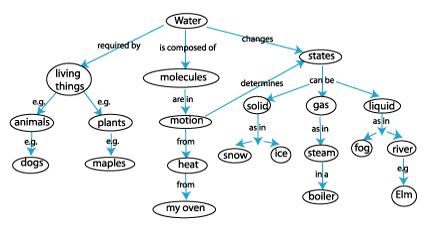
In our example, the key concept is water, and subordinate concepts are: 1) its importance to living things; 2) its composition; and 3) its various states and the effects of those states. Because it’s a visual image, it’s much easier and quicker for many learners to grasp the idea of water and all the related concepts than it would be for them to read a description. There are many variations on concept maps, but the basic structure consists of the following items:
- Nodes or cells. Nodes contain a concept, item, or question. In the example, the nodes are the ovals containing the main concept of ‘water’ and then the explanatory information beneath that concept.
- Links. Links are the lines explain the relationship between the nodes. In this case, the links are labeled with such words as ‘required by’ and ‘is composed of’. These words explain the relationship between the nodes. The arrows, of course, show direction and lead your eye from one node to the next.
The example demonstrates that concept mapping is a method of showing relations between ideas, images or words. Concept maps help you develop logical thinking as well as study skills because they reveal connections and help you see how individual ideas make up a larger whole. Concept maps are also very flexible and can be used to understand ideas of virtually every kind. You can make the maps simple or complex, linear, branched, radiating, or cross-linked.
There are other benefits of concept mapping as well. First, it’s a creative process similar to brain storming and can ‘unleash’ all kinds of new ideas, which is emotionally very satisfying. Second, concept mapping allows you to collaborate with one or more people. This enhances teamwork. Third, a concept map is a concrete, visual image. This means that you, as a learner, are better able to uncover any missing links that might not have been apparent in a printed text. Fourth, concept maps aid memorization, not just learning. Finally, and possibly most important, such maps build on the human capacity to recognize patterns in images. This means concepts maps are a better representation of how we model knowledge in the brain. This, in turn, improves learning and recall.
See the Products page for more information.