
Apply the Memletic Techniques#
 While there are many techniques spread
throughout all parts of Memletics, this chapter focuses on techniques
you use to memorize information and skills. You use these techniques
mainly during the reinforce step of the Memletic Process.
While there are many techniques spread
throughout all parts of Memletics, this chapter focuses on techniques
you use to memorize information and skills. You use these techniques
mainly during the reinforce step of the Memletic Process.
These techniques reduce the overall amount of time you spend on learning and memorizing material. By using them, you reduce your dependence on “rote learning”—simply reading material over and over until it (hopefully) sinks in. The techniques may take some effort to learn, however they pay dividends later. They help by reducing your overall study time and improving how well you remember what have learned.
Some of the techniques I describe have been around since ancient Greek times. Many I’ve adapted from recently written references. A few are the result of my own work and I’m publishing them here for the first time.
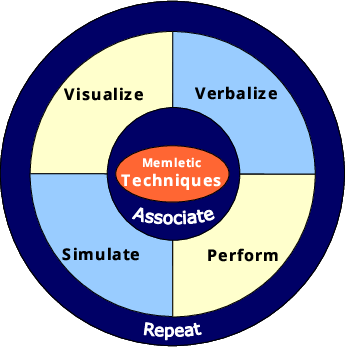
To make it easier to understand and remember these techniques, I’ve grouped them into six categories. These are:
-
Associate . Use basic characteristics of memory to learn new material.
-
Visualize . Use mental imagery to support goals, rehearse skills and reinforce other techniques.
-
Verbalize . Use words and writing to learn faster.
-
Simulate . Simulate real-life perform ances using basic or advanced tools.
-
Perform. Use specific techniques to learn skills and behaviors.
-
Repeat . Use repetition techniques to help you lock in what you’ve learned.
The rest of this chapter covers each of these categories and associated techniques in detail. Here is a summary of all the techniques I describe in this chapter:
| Category | Technique | Technique |
|---|---|---|
| Associate | General association | Peg events |
| First letter mnemonics | Mental journey or story | |
| Acrostic mnemonics | Roman Rooms | |
| Linked lists | Chunking | |
| Peg words | ||
| Visualize | General visualization | Mental rehearsal |
| Creative visualization | Strengthening techniques | |
| Verbalize | General verbalization | Mental firewall |
| Assertions | Scripting | |
| Simulate | Basic simulation | Advanced simulation |
| PC simulation | Role-playing | |
| Perform | Three stage skill | Shunt |
| learning | ||
| Anchoring | ||
| Part task training | ||
| Modeling | ||
| Performance variation | ||
| Overlearning | ||
| Repeat | Rote learning | Scheduled review |
| Flashcards | Programmed Repetition |
As you can see, there are many techniques in this chapter. You may find some of them useful, others you may not. This chapter is not a “prescription” you must follow to the letter. Feel free to choose and use the techniques that feel comfortable. Adapt them to your current learning activities.