
Why Styles? Understand the basis of learning styles#
Your learning styles have more influence than you may realize. Your preferred styles guide the way you learn. They also change the way you internally represent experiences, the way you recall information, and even the words you choose. We explore more of these features in this chapter.
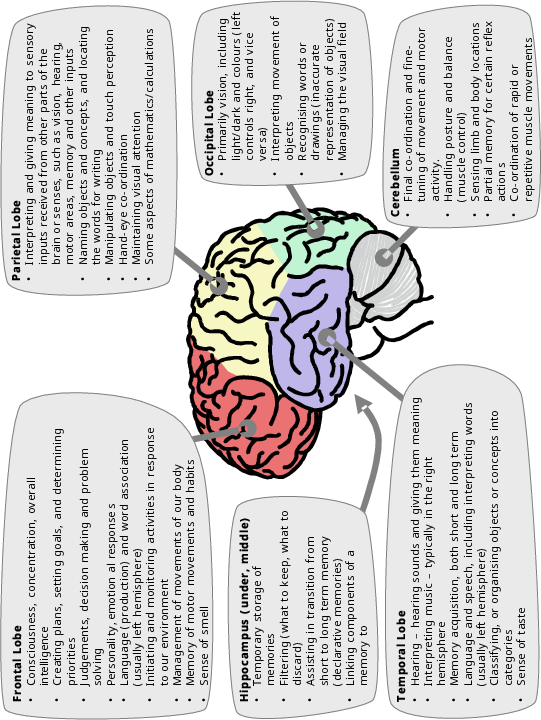
Research shows us that each learning style uses different parts of the brain. By involving more of the brain during learning, we remember more of what we learn. Researchers using brain-imaging technologies have been able to find out the key areas of the brain responsible for each learning style. Refer to the “Brain Regions” diagram and read the following overview:
-
Visual. The occipital lobes at the back of the brain manage the visual sense. Both the occipital and parietal lobes manage spatial orientation.
-
Aural. The temporal lobes handle aural content. The right temporal lobe is especially important for music.
-
Verbal. The temporal and frontal lobes, especially two specialized areas called Broca’s and Wernicke’s areas (in the left hemisphere of these two lobes).
-
Physical. The cerebellum and the motor cortex (at the back of the frontal lobe) handle much of our physical movement.
-
Logical. The parietal lobes, especially the left side, drive our logical thinking.
-
Social. The frontal and temporal lobes handle much of our social activities. The limbic system (not shown apart from the hippocampus) also influences both the social and solitary styles. The limbic system has a lot to do with emotions, moods and aggression.
-
Solitary. The frontal and parietal lobes, and the limbic system, are also active with this style.
I’ve based the Memletic Styles on two brain models you may have heard about. The first is “Multiple Intelligences” by Howard Gardner. I’ve broadened his model and made it more applicable to learning. You may know the other model as “VAK,” or the Visual-Auditory-Kinesthetic model. Neuro-Linguistic Programming (NLP) books also describe this model as “modality preferences.”
You may have also heard about the “left brain / right brain” model. In this model, the “left brain” is more logical, calculating and knowing, whereas the right brain focuses on emotions, feelings, and the visual sense. Recent research shows the brain is more complex than that simple model allows. Some activities are more commonly on the left or right sides, such as language on the left and music on the right. However, most of our brain’s functions are a rich interplay between both the hemispheres.