
Body and brain rhythms#
Your body runs to many cycles and rhythms. Two important cycles have a direct impact on your ability to learn efficiently. One is the circadian rhythm, familiar to us as the daily pattern of waking and sleeping. Circadian means once a day. The second less-known rhythm runs to a rough ninety-minute cycle. This is an ultradian rhythm. Ultradian means more than once a day. Both of these rhythms have an important role in learning. As well as these overall rhythms, there is also a brain characteristic I’ve called “Brain Drain” that you should also consider when planning breaks. Let’s look at these now.
The circadian rhythm#
The circadian rhythm wakes us up in the morning and makes us sleepy late in the evening. Set by daylight and darkness, the circadian rhythm is powerful. It drives the release of various substances in the brain at different times of the day to induce sleep or to wake you up. It does this because the body usually can’t work properly for more than twenty-four hours without sleep.
Researchers are yet to identify the exact workings of sleep, however much is already known sleep and learning performance. Sleep affects memory and learning both before and after a lesson:
-
Before your lesson. Without enough sleep, it’s harder to concentrate and focus on the material you are learning. The easiest way to forget something is to not pay attention when you are learning it! By making sure you have had enough sleep in the days before lessons, you are more likely to learn efficiently. This also goes for exams. Last-minute late-night cramming may cost you more because a lack of sleep makes it harder to remember what you do know during the exam!
-
After your lesson. Some evidence suggests the quality of sleep after a lesson may influence how well you recall what you learned. There is still much debate on this particular topic, however it’s clear that sleep is an integral part of good learning performance.
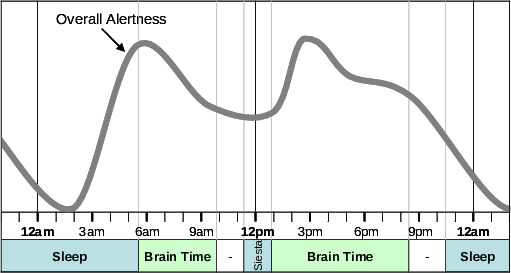
The circadian rhythm also has a large impact on your learning effectiveness through the day. The following graph gives a general indication of alertness during the day. The alertness curve reflects the effect that the circadian rhythm, and other rhythms, has on your body and brain. At the bottom of the graph there are examples of activities best suited to that time of day.
Note that this curve assumes reasonably standard hours of daylight and darkness, and a normal working day. Those in more extreme climates, or on different work schedules, may have a different alertness graph.
Of particular interest:
-
The morning brainwork period. The body and brain is usually more alert and creative earlier in the morning. This is usually the best time for brain work. If you think you are the opposite, pay attention to my comments further on about the “lark-owl” myth.
-
Lunchtime siesta. Around lunchtime, your body naturally wants a short sleep, typically between 11am and 1pm. Some cultures have given up the afternoon siesta for continued work, often with a loss of productivity and safety. Work accident statistics show for example that workplace accidents are more likely to occur during and after this time. If possible, a brief 30-minute nap during this time can bring you many benefits, including better concentration and alertness for the rest of the afternoon. If a nap in the office cubicle or classroom is not possible, know that you probably won’t be at peak performance for a while. This may help you schedule your activities to make the most of this down time.
-
The afternoon power period. After this siesta time, the afternoon is usually good for productive brainwork, however it’s also during this time your body is also primed for physical achievements.
-
The evening wind-down. As the evening progresses, your body prepares for sleep. Your body temperature drops, and sleep hormones increase. You still feel reasonably alert during this time though because of another body cycle. Your body has an inbuilt system that usually prevents you from falling into deep sleep fewer than fifteen to nineteen hours since you last slept. Once you pass this period though, it’s usually a steep descent into sleepiness.
Lastly, let’s put to rest a common myth about sleeping patterns. The “lark-owl” myth, although popular, is essentially unfounded. The myth is that you are either a morning person (lark) or evening person (owl). In truth, you can switch from one to the other within a few days simply by going to sleep thirty to forty-five minutes earlier or later each day. Given the body’s natural brainpower period earlier in the morning, there may be benefits in switching to be a lark if you are currently an owl.
The ninety-minute ultradian rhythm#
Although you may not have heard of it, the ninety-minute ultradian rhythm also affects your learning performance. Essentially the brain works on a ninety-minute cycle of alertness and rest. You feel alert for about seventy minutes, and then your alertness drops for about twenty minutes. This natural cycle helps your brain take a break. Consider taking a short break when you feel the first wave of tiredness wash over you, for example at the first time your eyelids drop. Perhaps do a relaxation exercise. Also, try to keep lessons or continued mental activity to within 70-80 minute periods.
In the early afternoon, you are especially susceptible to tiredness when the sleepiness of the circadian rhythm and a dip of the ultradian rhythm coincide. Add the effects of a big lunch and you get a triple-dose of sleep inducing agents. Again, it’s better to try to work with this natural schedule rather than trying to work through it.
Brain drain#
Prolonged mental activity without breaks can literally drain your brain of two key materials needed for learning and recall. These materials are neurotransmitters and glucose. “Brain Drain” is in this section of the book because it’s a cycle of use and replenishment of these key materials. You need to take this cycle into account when planning breaks during study.
-
Neurotransmitters. The brain only has limited levels of neurotransmitters available at any one time. It takes time to create more as the brain uses them up, especially during learning. Prolonged mental activity without breaks can reduce neurotransmitter levels in key areas responsible for learning, making it harder to learn effectively.
-
Glucose. In addition, prolonged mental activity can also drain certain parts of the brain of glucose, the key nutrient the brain uses for energy. This may be more pronounced as you get older. In addition, study that involves sitting inanimate at a desk or in front of a computer lowers your heart rate. Lower heart rate means less blood delivered to the brain, which then means less available glucose for your neurons.
While there is still more research needed in this area, these points further support the case for regular breaks during learning. There is an interesting twist here though - the ultradian rhythm prefers a more relaxing break, however light exercise would likely best resolve “Brain Drain” described here. Personally I try to alternate between these two types of breaks.
So what’s the best pattern to use when studying or learning? In summary:
-
Get enough good sleep, both before and after study.
-
Get up earlier in the morning, and do more study in the morning period (if possible)
-
Don’t study intensively for more than forty to forty-five minutes at a time
-
Alternate breaks between light exercise and relaxation. Try to time the relaxation break to your ultradian rhythm.