
General association principles#
What color would a rollerblading cat be? How big would it be? Where would it be rollerblading? If you answered green, about the size of a car, and over the Golden Gate Bridge, then you have just seen another example of how association works. The image is creative and unusual, so it sticks better in your memory. We use this feature of memory in various techniques to improve your retention.
Good associations include senses, emotions, situations, categorization, exaggeration and combinations. There are also some basic steps to follow when creating associations. Next I talk about these two points and provide some thoughts on practicing association. I also discuss the principle of chunking.
Features of good associations#
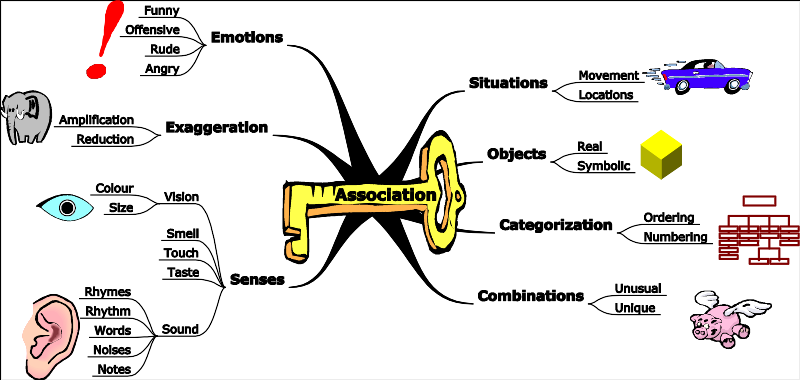
There are six key features that help create powerful associations. The following diagram and points describe these features:
-
Use the senses. Use many of the senses. Try to include vision, sound, smell, touch and taste. With vision, think about color, size and shapes. For sound, think about rhythm and rhyme in words, noises objects might make, and potentially use music as well.
-
Use emotions. Emotions also help you recall associations. Using humor is powerful, as is using offensive, rude, or sexual content! Be aware though that your subconscious may block some negative emotions (sadness and anger for example) if they are close to personal experiences.
-
Use situations. When you associate two or more objects, imagine them in situations or scenarios. Use movement or relative locations to each other. Examples include crashing objects together, placing objects inside or on top of each other, combining them to form some other object, and more.
-
Use categorization. Before you memorize multiple pieces of information, try to categories them. You more easily recall four groups of four items than one list of sixteen items. When you number or order items, try to work out a reason for ordering them in the way you have, even if it’s simply alphabetical. It’s even better if you can find a creative way of ordering the items.
-
Use exaggeration. For some reason, the mind loves exaggeration. Exaggerate everything you can about each association. Exaggerate the senses by using bright colors, or making objects huge or tiny. Exaggerate situations by using unique or unusual circumstances. Exaggerate emotions by making the objects themselves part of the emotion. For example, an object laughing at the situation it has found itself in.
-
Use objects. Use tangible, real objects in your associations, as these are easier to visualize. Instead of using love for example, perhaps see an object with a big pumping heart. It’s pumping fast because it’s in love with some other object.
-
Use combinations. Combine as many of these features as possible, in unique and unusual ways. You more easily recall an association that is bright, colorful, loud, and using a crazy situation, compared with one that relies on visual uniqueness only.
A good way to remember these seven features is to think of association as EESSOCCiation. Each of the first seven letters stands for one of these features—Emotions, Exaggeration, Senses, Situations, Objects, Categorization and Combinations.
Association and the Brain’s Neural Networks
Recall that the brain works by creating and changing networks of neurons. This holds three important lessons for us. Firstly, the brain learns new information by expanding existing networks. It does not usually create a completely new network that is isolated from the rest of our experience base. We learn faster by relating new experiences and information back to what we already know. This builds on existing neural networks. Secondly, the brain learns such information by creating relationships, associations, and other structures such as categories and hierarchies. We remember more accurately when we spend more time creating relationships and associations between existing and new content, and within new content. Lastly, the brain loves novel, unique and exaggerated relationships and associations between content. Remembering a cat next to a pair of rollerblades is later recalled a lot less accurately than remembering a huge cat rollerblading across the harbor bridge. The same rule applies to learning serious content. The concepts may be serious but we can remember it far more easily if we create unique and exaggerated relationships with them.
Steps to create an association, with an example#
The steps to create associations may seem complicated at first. Stay with it. After you have done a few associations it becomes easier. Read the steps below. I’ve also included an example—how to memorize that one of the roles of engine oil is to cool the engine.
-
- Choose the known key image. Choose an image that links to the item you wish to remember. This is typically an image that a) is an object, and b) links to information you already know.
Example: Our known key word is oil, however we want to choose an image that we see when we think of oil. Let’s use an image of oil in the sump (bottom) of the engine.
- Create the target key image. Think of an image that reminds you of the piece of information you want to link to.
Example: Our target piece of information we want to remember is “cools the engine,” however it’s hard to create an image from that fact. So we choose an image that’s related to cooling. The first one I thought of was a “Polar Bear.” If I think of oil, and then polar bear, that triggers the thought “cools the engine.”
- Consider both the known and target key images. Visualize both of them and see if there are any obvious comparisons you can exploit.
Example: There are many comparisons! Oil is black (usually), polar bears are white. A bear is usually much bigger than an engine. A polar bear uses oil in its hair to keep it warm.
- Create the primary link. Choose one of the association features (senses, emotions, situations, categorization, exaggeration, objects and combinations) to link from the first to the second. Consider some of the comparisons you made, and then perhaps take the opposite of those (the most obvious links don’t always work the best, so use creativity). This is your primary link. Make this link stand out on the known image, so it’s the first link you think of when you think of the known key word.
Example: I chose situation as my primary link. I see thousands of tiny polar bears swimming in the oil of the engine.
- Create supporting links. Depending on how critical the knowledge is that you are learning, you can then create more links to support the primary link. If this is an important association, work through the association features and create more links.
Example: More links could include: For senses, see a visual of a white bear swimming in black oil. For emotions, see the bears having a great time sliding down the metal surfaces of the engine, cooling it as they go. For exaggeration, we’ve already exaggerated both the size of the bears (tiny) as well as their number (thousands).
- Test it out. Clear your mind for a moment, and then think of the known key word and the image it creates in your mind. Is your attention first drawn to the primary link, which then triggers the second target image? If not, spend some more time focusing on enriching the primary link so it stands out the most when you think of the object.
Example: Try out the visualization. Think of the oil sump. Visualize thousands of polar bears swimming in the engine sump. Imagine seeing the oil on the end of the dip stick. Look closely. What do you see?
Those are the basic steps to create an association. Like I said above, it may seem complicated at first but it does get easier.
As well as these features and steps, here are two further tips for creating good associations:
-
Preserve purity. Only use objects and features involved in the association you are creating. Involving other unrelated objects can distract you.
-
Keep it simple. If you find you have to create elaborate stories to link two simple images, you may want to try to find simpler links. The best associations are those that stand out in the mind without needing mental gymnastics to get to the target key word!
Association needs practice#
Association is an essential memory skill that takes some time to understand and do well. It does work though. Association is the primary method that memory champions use to win international memory competitions.
You can shorten the time to learn association by using it regularly, as well as by doing some simple exercises. Try spending ten minutes a day for a week doing simple associations. Choose two unrelated objects, and go through all the key association features above. Think of many ways to associate those objects. Try to create the most outrageous and illogical links between them.
You can get better at association by practice as well as using it for real learning work. You can learn some of the following techniques while using them to remember content. For example, I learned peg words twenty to one hundred while memorizing a list of one hundred review points. These review points were from training flights leading up to my pilot’s license. As I recalled the list, it also helped strengthen those peg words I had only just learned! Indeed, one author named a memory system the “Self-Enhancing Matrix” because while you use the system you also strengthen your ability to use it.